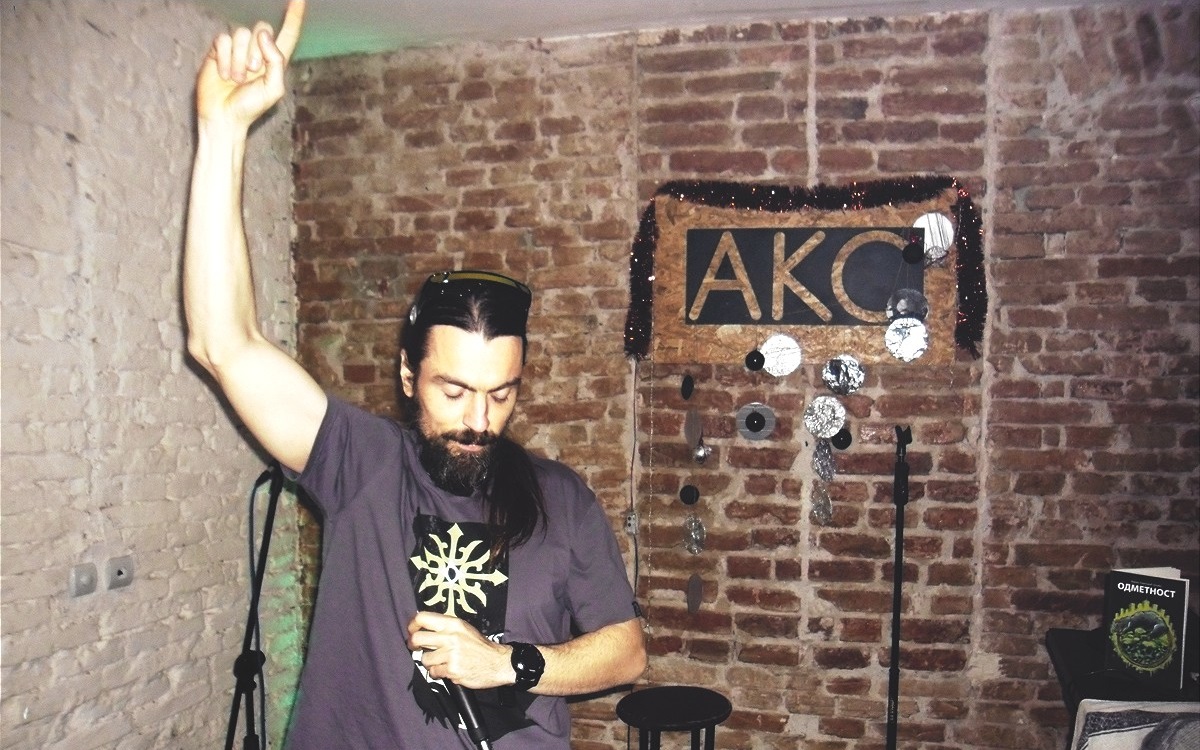
This is one of those interviews that has defied publication date for years, just like Shkabo (Boško Ćirković, Belgrade Syndicate) himself, so this article is in the spirit of the topic we are dealing with here. The reason for that was the second wave of the C-19 epidemic when everything kind of stopped. It was the night between January 11 and 12, 2020 – the promotion of the collection of poems “Odmetnost” (eng. “Renegadeness” – translation by catching the spirit of the word, while standard translation would be Departing/Digressing) followed by a musical performance at the former “AKC”. We are publishing the interview in its entirety, retroactively.
alxspirit: What can you tell us about your book, the collection of poems “Odmetnost” (eng. “Renegadeness”, or Departing/Digressing)? How would you present it to the public?
Shkabo: I don’t want to sound pretentious by saying that it is a “renegade manifesto”. This is my personal account of that departing from some current world that has become too virtual for my taste. Earlier, people were turning away from the Turks into the forests, while this is a representation of turning away from the current virtual trends in life – from YouTube to various virtual trends in life. That’s the common denominator of all those songs. They are actually not all presented as a “con” to everything that I see as bad, but there are also a lot of things that are presented as “pro” in something that I essentially see as good and the opposite of what bothers me. The first poem in those pre-rhymes is very short, only 4 lines long, and goes like this:
“I live to speak, I speak to live,
I support the songs I record with my deeds,
I love to fight, I fight to love,
I sail through storms, together with my people.”
(free translation/interpretation in English)
I think it’s pretty much a “pro” song, and basically it’s a “con” to anything that isn’t it. It is not a current story, nor any current life motto. That’s just it – that’s what it’s about. Some of those songs have already been recorded in audio form and released as rap songs, and some have not and will never be, while some have yet to be released in audio-visual form.
alxspirit: Someone once said, maybe even you, I’m not sure, on the account of Hip-Hop: “Hip-Hop is a good servant, but an evil master!”. Were those once your words or not?
Shkabo: Even if they weren’t, I agree. If I said it – I said it very well! Hahaha!
alxspirit: In that sense, Hip-Hop can be interpreted as a “double-edged sword”. It happens that you deal with some social phenomena, which you perceive as negative, in your songs. How do you deal with it as artists when you come across fans who have completely misinterpreted them?
Shkabo: I have a ready answer to that because we encountered that question in the stands as well. Times have changed a bit and people now look at things a lot more literally, but I really can’t be a guardian for minors and the weak-minded. I approach the people I interact with as equals – both when they are younger and when they are older than me. I think that we all have enough brains that if we listen to a song like “Alal Vera”, or the song “Svedok (Saradnik)” (eng. Associate Witness) that we made as the last one in that domain, even thinking that it is completely resistant to misinterpretation because of some of the lyrics, which are absolutely disgusting to me if you interpret them literally. For example, “I never loved this city and country”, or “all my old friends – I betrayed them all”. If that’s completely legitimate behavior for someone, I really can’t be a guardian for minors and feeble-minded people. There are parents (and other instances) for that. I’m sorry that such a time has come when there are more and more such interpretations, but brother, unfortunately, because of such things, we are now somewhat defensive. As a group, we are much more careful now, so we no longer dealt with some topics in that way, and I think that way is missing out a little because it is fun. That’s why I (as a solo artist) f*ck around much more with that topic.
alxspirit: People know (more or less) how many members there are in the Belgrade Syndicate, but what about the “Discreet Heroes” and the people who somehow contributed to the whole story? How many of them are actually in the shadows and what is their number?
Shkabo: I don’t know, there’s a huge number of them. Their number is huge because without that support – the group does not exist. Without the support of the audience, the concert in the “Belgrade Arena” would not have happened. Regardless of the number of people, and if the audience didn’t react the way they did, it would certainly be easier to hear how bad the sound system was and all those various “holes” in the process. As an author, if you’re honest with yourself, you’re aware of where you went wrong, what could have been better and all that, but when the audience comes and brings it all literally on their backs and with all that energy – in some moments it crosses that relationship and crosses the line “this is the audience – and this is Belgrade Syndicate”, and that’s why the Belgrade Syndicate has that line that says “it started as a rhyme, then it grew into a movement, now it’s a philosophy”. It is absolutely not just ours anymore. I don’t even know how many more of us there are officially in the group. That philosophy, and the movement, is much more important. At one point, that movement also became a way of thinking. It’s really not just us anymore, nor are those words just ours, for a long time now. It’s not a platitude at all – it’s just as important; if not more important, because without the audience and without that support there is nothing.
alxspirit: How did the mini-release “Sindikalna Borba – Oni Su” (eng. The Union Struggle – They Are) came about? What inspired and launched that entire release?
Shkabo: Well, now I’m trying to “rewind the movie” (serbian slang for “put the pieces together”) because it was a long time ago. That was in 2006. Specifically, I think we tried to make a more articulate song than “Govedina” (eng. Beef) was and to just make that kind of deviation and make it a point to all those political songs, but I think “Sistem Te Laže” (eng. The System Lies to You) articulated it even better. That was the absolute separation of the “Belgrade Syndicate” and the entire generation that had been expecting something from them since 2000. Hence the very meaning “They are” – they are them, and we are us. That was some inspiration for that song, and the release had a humanitarian character related to financial assistance to “safe houses” (protection program for victims of domestic violence), which was an attempt to show that we don’t want to make money from it, but to donate that money to a good cause. After that, we ran into the story about the “Fifth Park” (civil action of saving park for children and youth against new buildings on the spot), so that continued. That was the moment when there was some initiative, even broader than the “Belgrade Syndicate”, to wake up those civil movements in terms of some changes in their region. But, everything changed a lot, people seem to have been disappointed too many times.
alxspirit: How did the collaboration with the ethno-group “Trag” (eng. Clue) looked like, regardless of the “media dust” that arose after the release of the song “‘Till next year in Prizren”?
Shkabo: It’s quite a strange and very interesting story. Less than a month ago, Fedja and I had a forum in Banja Luka organized by students of the Faculty of Political Sciences called “An evening with Discreet Heroes”, where we talked about our various experiences, including experiences related to that song, and we met physically for the first time really with most of the people from the ethno-group “Trag” (because they are really a large group), while in fact the whole cooperation with them took place over the Internet. We came to them through our friend Djole from Banja Luka, who had something to do with the recording of the video for their version of the song “Crven Cvete” (eng. Hey, Red Flower!), which I actually heard and thought was their song. The first version of the beat/matrix for the song “‘Till next year in Prizren” contained a sample of the song “Crven Cvete” (eng. Hey, Red Flower!) performed by the ethno-group “Trag”. We later found out that it was not their song in the original, but that they obtained the rights to have their cover on the Internet after a lot of trouble. The energy that this song contains is evident. That song is beautiful to me. That song (“Hey, Red Flower!“) was written by a woman from Kosovo and Metohija, in a refugee colony. She didn’t give the right to just anyone to sing it and post it on the Internet, and I completely understand her because it’s an intimate thing, but she allowed the ethno-group “Trag” to keep their version on the internet. Then we came to the ethno-group “Trag” who were like “We want to work together”, and we came up with the idea of creating an original chorus. Valentina from the ethno-group “Trag” wrote the text for that chorus, they came up with the melody… After that, we communicated over time via Viber app and the Internet. They recorded in their studio, we mixed at Prota’s studio – and we put it together. Prota is our friend and producer. In addition to inserting the fiddle, he also came up with the idea that the song simply cannot be released without a music video. He found a man who did the video-editing and that’s how it started. It’s been more than a year and a half since the song came out, and after a year and a half, we actually met for the first time and never performed it live together. We performed the song 4 times live with the Theological Choir of Prizren, but we never performed that song with “Trag” and we said to each other when we met “We really have to do it!”. It was a very interesting collaboration, and there were also some a bit “hard” moments, because they are really more serious musicians than we are and they approach this work much more seriously, so there were some moments in which communication was a little more difficult, especially because we did not see each other in person at that moment, but corresponded by messages, and it also showed how much the written word via Viber app, or such, cannot really serve as a communication tool that will convey all those nuances. We don’t look at each other, we don’t see that facial expression, so someone misunderstands something, and similar, but in the end, everything turned out more than well. I hope that we will perform that song together as soon as possible.
alxspirit: You shared the stage with the group “Asian Dub Foundation” at “Arsenal Fest” in 2016, and you have a similar ideological concept. In the future, does the Syndicate plan to deal with some geopolitical issues like ADF, and not just local ones?
Shkabo: Yes, definitely! In general, we dealt with that as well. We also read a lot of literature of that kind, so we will certainly deal with that as well.
alxspirit: Impressions after tonight’s performance?
Shkabo: I had a great time. It was fun for me. I haven’t been to Jagodina (eng. Strawberry City) for about 6 years and I’m really glad I was here.
Shkabo: Facebook, Instagram, YouTube, YTMusic, Deezer, Spotify, Last.fm, Apple.
Belgrade Synidcate: Official web-page, Official web-shop, Official YouTube channel.
Date: January 11/12, 2020. | Location: Former “AKC”
Photography: alxspirit | Video: YouTube/@skabomaestrobs, YouTube/@etnogrupatrag
For keeping in touch with us visit/follow our Facebook page in English.
For more photos and video material visit/follow our Instagram account.
For more information about the upcoming articles visit/follow our X account.
 alxspirit