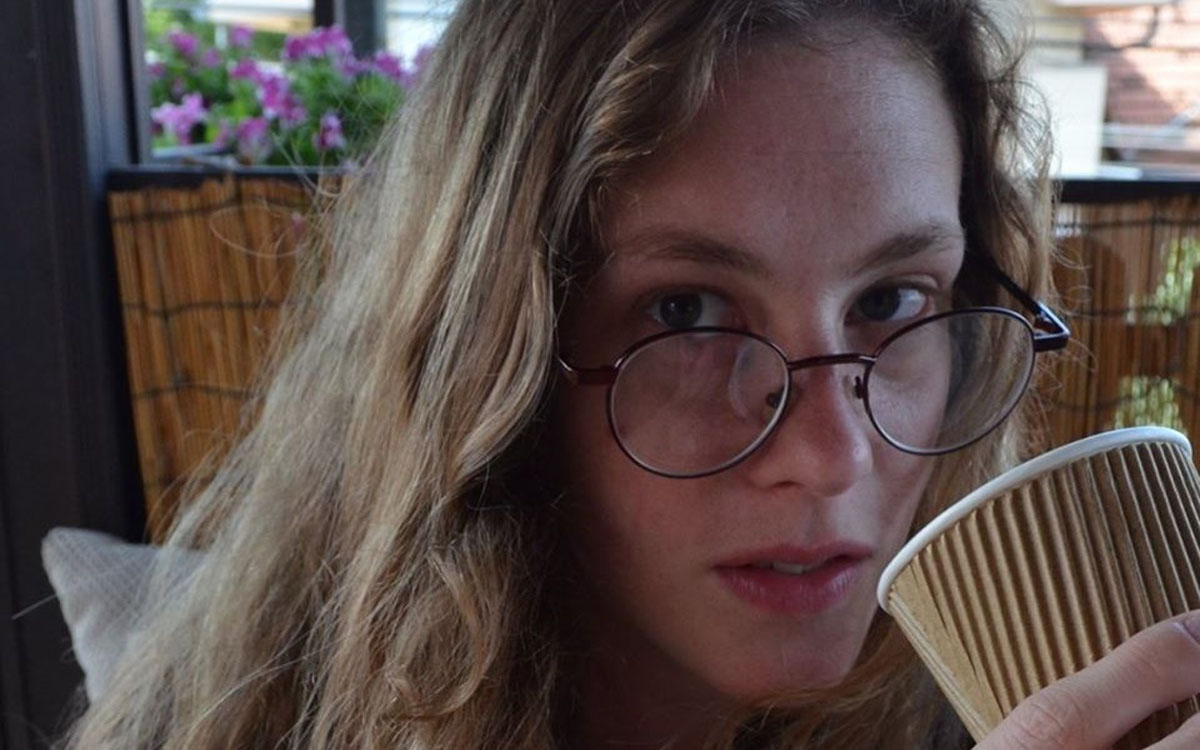
Ksenija (eng. Xenia) Milićević is a Serbian academic painter from Jagodina. She was born in 1992. She graduated at the Faculty of Applied Arts in Kragujevac (Department of Wall Painting) in 2016 in the class of prof. Jelena Šalinić. In the same year she enrolled academic master studies with prof. Slobodan Marinković. She is the daughter of the late and famous naive painter Predrag Milićević – “Barbarien”. She had several collective and student exhibitions, and her first solo exhibition was held as part of the defense of her Master’s thesis last summer (July 16th – August 8th, 2019) at the Homeland Museum (serb. “Zavičajni muzej”) in Jagodina, entitled “Dreams – Communication with self”. Back in the time, we did an interview for the press release, parts of which were used for an article on the occasion of her exhibition – and now, after a little less than a year, we are publishing her interview in full, in digital form.
alxspirit: Tell me more about your exhibition that’s opened a few days ago (July 16, 2019) at the Homeland Museum in Jagodina, and about your Master’s degree. What were your impressions and was it difficult?
Xenia: As for my creativity process, there were also ups and downs. It took a long time. I had one major break after which I went into action again, and then somehow started the ascending path; and as for the exhibition itself, the attendance was excellent, and everything turned out better than I had hoped.
alxspirit: How did the defense of Master’s degree go and how did you feel after receiving the highest grade possible?
Xenia: Honestly, I was expecting to get a 10. I was pleased with my work. I was confident. I have known my professors throughout my education at the Faculty and at the Master. We have great communication, we work in small groups. We know each other well enough, so I didn’t have any stage fright in front of them. I also knew who was going to object me or what to ask me, so that defense went well. The grade that I received, well, I expected it, in a way … And it didn’t really matter that much to me. Somehow, I experienced it as a formality that we have to complete.
alxspirit: Tell me about alternative forms of painting.
Xenia: I enrolled in wall painting. That’s what I finished. However, at the Master program I was more devoted, in particular, to classical painting, painting on canvas, and here, painting on plexiglas where I also introduce some new materials in order to evoke this whole “dreamy” form. I don’t do wall painting so much. I don’t deal with that anymore. I’m more dedicated to classical painting, but I’m just allowing myself to bring something new to the whole story. Of course, this has already been seen and used, but I’m just trying to find “my” materials for work.
alxspirit: How do you translate dreams onto canvas?
Xenia: I have a different approach for each picture. I don’t approach every scene the same way. Some of the pictures are specific scenes of my dreams. Of course, after and through reason, or for the sake of art, I subtract and add something, and some pictures I do totally subconsciously and they are not concrete scenes from a dream, but I try to translate the dream, which is our unconscious part, into a picture so that I pull out that subconscious, whether I dreamed it or not. It all depends on the picture. Sometimes I am drawn to some motive I see in nature that has nothing to do with dreams. Sometimes I take something from my subconscious part that happened to me before, or what I may have seen, remembered …
alxspirit: I’ve noticed that “forest” is the main motive. Tell me, why the forest and what forest represents and symbolizes through your work?
Xenia: I perceive “forest” as one of the strongest symbols of the subconscious, and in general, forest is the epitome of a person’s entire psychological life, because in the forest there is absolutely everything that exists in our psyche. There is that dark part. There are trees that are strong. There are trees that are quite old. There are those young. There is plenty of light. Games of these contrasts, light and darkness are common. This is how I experience my being; but on the other hand, forest also occurs in my “reasonable” life. I was exploring nature side by side with my dreams and my subconscious. I wanted to be in touch with nature and the forest, and it all somehow fused into the same story. In the forest, of course, one of the main motives is wood; and the wood is also interesting because it is strong and on the other hand fragile. It can last for centuries, decades, it has roots … Roots go to the earth, into our subconscious, into our past, while I experience the canopy as our superstructure, as something we have learned and gained, as our aspiration for the Sun and light.
alxspirit: How much influence did you have from your father’s work that left a deep mark in domestic (and international) art scene?
Xenia: At first glance, people might say that there are no similarities, but to me personally, him as a personality, as well as his work, left a deep mark on me. He has always emphasized to me to be honest in what I do, and that is the strongest influence he has left on me. I always try to work honestly, that’s why I study my subconscious and my past; and not just personally, but the entire collective too, all of humanity, or the entire Universe, for the simple reason that I strive for honesty. We don’t have very similar motives, or that artistic approach to the painting, but I also see some similarity in expressiveness, in not paying attention to some things that painters often pay attention to, such as, for example, very often anatomy or a concrete depiction of reality, and I tend to find my experience of all this, my experience of the environment, around me and in me.
alxspirit: Your exhibition was thematic and really beautiful. Tell me, what are the plans for some future exhibitions; will the theme remain the same or are you planning to introduce some new forms?
Xenia: Honestly, I think this story will continue because I feel I am just at the beginning, that I still can and have to explore. There is plenty of material out there to work with. Some things are sure to change. I also plan to introduce new materials, especially those from nature. I plan to go deeper into the core of myself, into the core of the unconscious; and specifically, when it comes to nature, to immerse into the very core of the very bark of the tree, the very meaning of the forest, and the light, and that darkness … Surely there will be plenty of room for progress and plenty of room for change in that in a visual sense, but as for the very subject of dreams and the study of archetypes and symbols of the unconscious, I think I’ll stay in that for years.
alxspirit: Given that you stick to certain topics and certain philosophical aspects, the nature of dualism and the like – is all your work so far a kind of “conceptual art”?
Xenia: It can be. So far there is an indication to that and I think it will go in that direction, I just need more time, I need more work, I need more knowledge, and even more courage and freedom to go into it all. I get the impression that with each next painting I go a step further in terms of that freedom, and I can’t exactly imagine, and I should not imagine – that end product; but I think there is some possibility of going into that “conceptual art”, to go even further into this symbolism and into the philosophy of art itself, than I do now.
alxspirit: As a young artist, how do you interpret what is called “outsider-art” by some artistic jargon?
Xenia: Since (my) father was an “outsider”, I am attracted to this and I love this whole line of art. I am also attracted to it because I grew up and was in contact with these “outsiders” and “naivetes”. I think these are brave people who do not make compromises and I think that art should never make compromise with the environment; that it should be what it is, that it should represent what it is, to resist the time, to resist some fashion trends.
alxspirit: Are, in fact, true art and all the essential philosophical questions happening at the boundaries of some social margins?
Xenia: Very often it is like that, because artists, again I say, are brave people who need to explore, who need to create; and we can only advance in a way where we cross a border. Someone might make a mistake, but without risk, nothing can be done and it’s impossible to move forward.
alxspirit: Do you have a picture that you would single out for this interview, in the sense that you say something interesting about it, from your perspective?
Xenia: Basically, most of the pictures have an interesting background, an interesting story. For the next interview I would save “The Road to Black Top Mountain” and for this interview I would single out “Memory of the tapestry from my grandmother’s bedroom (what’s behind the curtain?)”. That picture didn’t come from a dream, I didn’t dream that scene, but I worked it out from the subconscious. I was doing it unconsciously. I took the canvas, without thinking, without any idea, without any desire to do anything here, or to prove myself … And then I started to paint. That picture, so to speak, I finished it, left it, and it stood on the wall in my studio. I used to watch it and it made me angry, some fear… The restlessness woke up as I looked at it and it was one of the more interesting pictures. It still is. And then, in fact, I realized why I was “scared” of that picture. I have a memory of a tapestry from my grandmother’s bedroom that depicted a girl in a baroque dress sitting alone at a table writing a letter by a candle. Behind her was a red curtain that was falling down and parting at the floor, and behind it was a dark gloom. I was always scared of what was behind that curtain and my grandmother always had to hide the tapestry behind the closet when I came to her. The same emotion comes to me when I look at that picture and in a way, maybe a little because of that darkness and because of those red colors, it reminds me of that tapestry and that emotion that I otherwise didn’t feel for no reason in my life often.
alxspirit: You graduated in the class of professor Jelena Šalinić at the Faculty of Applied Arts in Kragujevac. What can you tell us about your experience with her?
Xenia: When I enrolled in the Faculty, I honestly didn’t know much about painting. Jelena is a great professor and I can thank her for many things because she was always dedicated to her students. She always had the desire to move forward. Even now she brought one book and showed it to me at the exhibition, and recommended that I read it. The book was written by David Lynch, who also deals with dreams and draws ideas from dreams. She was always dedicated to us. She was able to recognize what I was striving for, what I wanted, even though I often did not know it – I often wandered. At one point it was a little more difficult to find communication because I couldn’t always understand her, but in the end we found great communication. She left a certain mark on me. She taught me that I have a lot to do, that I have to think a lot about what I do, to read, and not just do the classic “finishing” of a painting, but that I have to devote myself to it in every way possible.
alxspirit: Thank you very much for this conversation. I wish you much success in your future work. I hope for new exhibitions.
Xenia: Thank you.
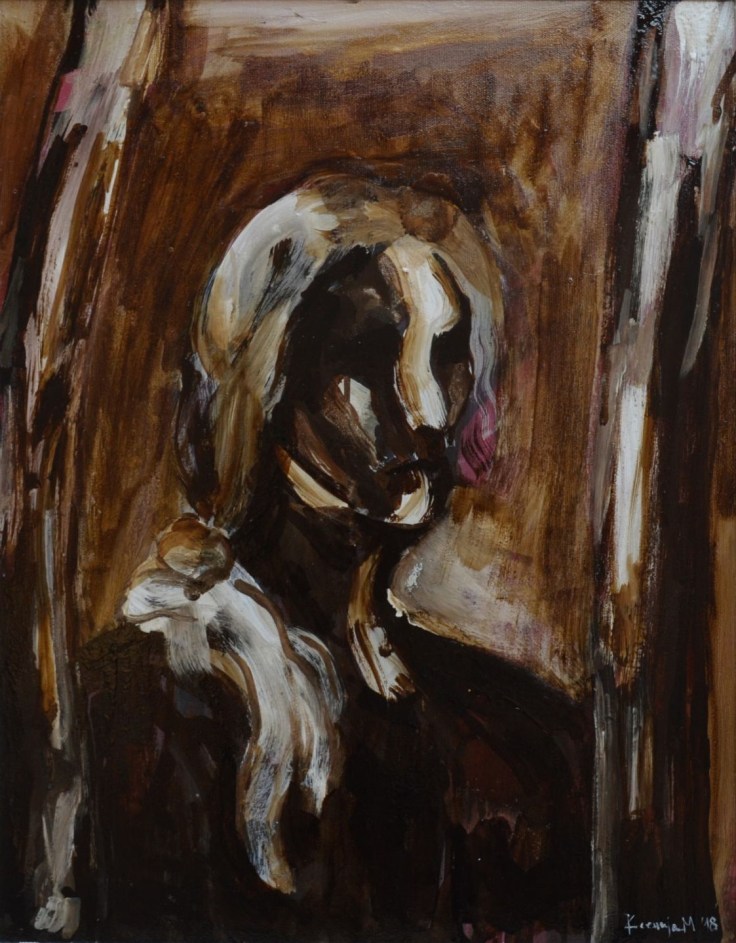
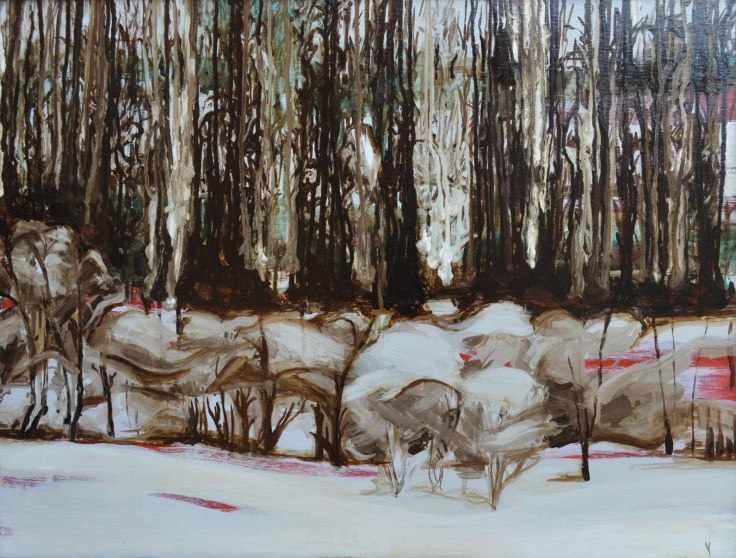
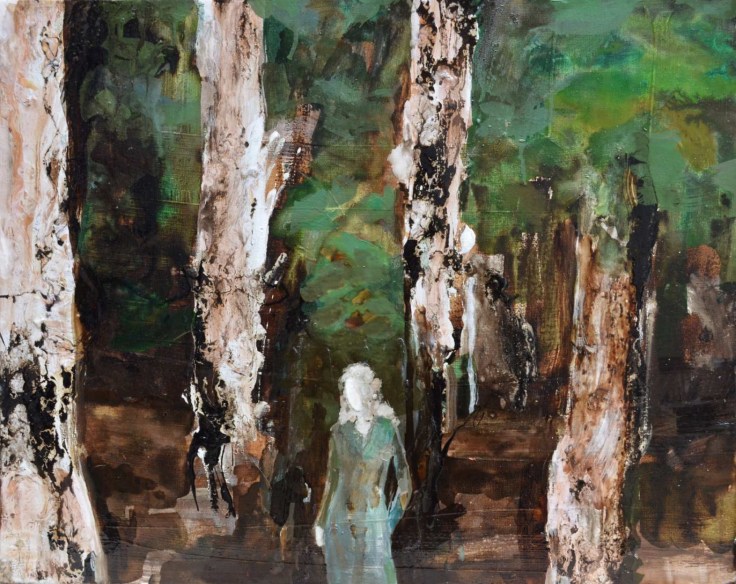
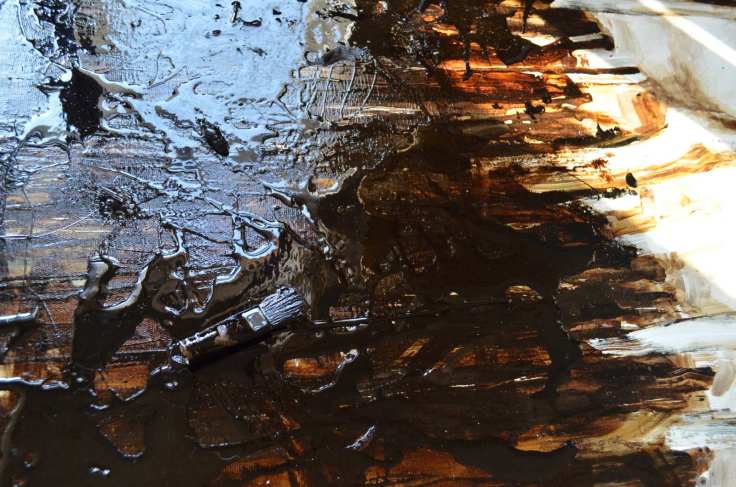
Photography and art: Xenia Milićević.
For keeping in touch with us visit/follow our Facebook page in English.
For more photos and video material visit/follow our Instagram account.
For more information about the upcoming articles visit/follow our X account.
 alxspirit